
Point Machine Monitoring: Reading the Drive-Current Signature
The point machine is the most-operated piece of trackside equipment in the network, and a single failure to detect can stall a junction for hours. Almost every point failure announces itself first in the motor's drive-current signature — a rising friction trend, a stretched throw time, an obstruction that holds the current high. This guide covers how a point machine works, how to read its current curve remotely, and which signals to monitor to catch a failing machine before it drops detection.
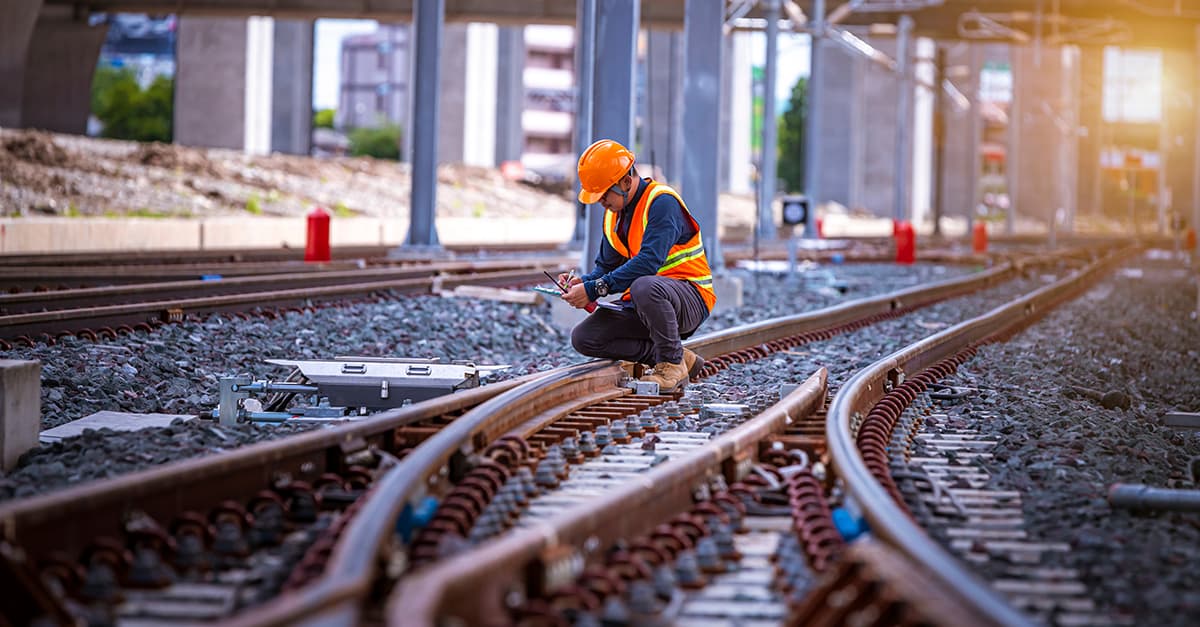
What is a point machine?
A point machine (or switch machine) is the powered actuator that moves a turnout's switch blades between the normal and reverse positions, then locks and proves them. A single operation runs through a fixed sequence: the machine unlocks the points, throws the blades across, drives them home against the stock rail, engages the lock, and finally makes detection — the contacts that prove to the interlocking the points are fully seated and locked in the commanded position.
Most machines are electric or electro-hydraulic. Whatever the prime mover, the same logic applies: the motor draws current through the operation, and detection is the safety-critical proof at the end. No detection, no cleared signal over the points.
Why monitor point machines?
Points are operated thousands of times a year and live outdoors in ballast, exposed to dirt, water, and temperature extremes — from ice and snow that pack the switch in winter to summer heat that expands the rail and stiffens the throw. They are consistently among the largest single contributors to signalling-caused delay minutes. The failure that actually stops trains — loss of correspondence, where the points won't seat and detection is lost — is almost always the end of a slow mechanical decline that was visible in the drive current weeks earlier. Monitoring exists to convert that decline into a planned maintenance visit instead of an unplanned, peak-hour failure.
How the current is measured
The whole technique rests on one practical question: how do you get the motor current into a monitoring system without touching the vital signalling circuit? The standard answer is a split-core current clamp — a current transformer (CT) that closes around the point machine's supply conductor inside the location case. Because it's clamped on rather than wired in, it senses the current non-intrusively: nothing is broken into the drive circuit, so the monitoring stays galvanically isolated from the signalling and can be retrofitted without a circuit alteration.
The clamp's output is conditioned to a low-level signal — either a small voltage or, via a transducer, a 4–20 mA loop — and landed on an analog input of the data logger or RTU at the site. From there the chain is:
- Sample fast enough to see the shape — the input is scanned at tens to hundreds of samples per second, so the in-rush, unlock, throw, and lock phases are resolved as a waveform rather than collapsed into a single average.
- Scale to engineering units — the logic application converts the raw analog count back to amps using the CT ratio and a calibration factor set at commissioning.
- Pair with digital inputs — detection/correspondence and commanded position are read as digital (volt-free contact) inputs, so each current waveform is tied to a known operation and outcome.
That combination — one analog channel for the current clamp, a couple of digital channels for detection and command — is all the instrumentation a single machine needs, which is what makes fleet-wide retrofit affordable.
The drive-current signature
Every throw produces a repeatable current-versus-time curve. Learned per machine and per direction at commissioning, this signature is the single richest health indicator a point machine offers. It has four recognisable phases:
| Phase | What's happening | Healthy shape |
|---|---|---|
| In-rush | Motor starts under load | Brief current spike, then settles |
| Unlock | Lock is driven clear of the blades | Distinct early peak |
| Throw | Blades travel across, friction-dominated | Flat, stable plateau |
| Lock & detect | Blades seat home, new lock and detection made | Final rise, then current falls to zero |
Because the curve is so repeatable, deviations are diagnostic. The shape tells you not just that something is wrong but where in the operation it is wrong:
- Raised throw plateau — friction is climbing: dry slide chairs, worn rollers, a stiff switch. The classic early-warning trend.
- Current held high past normal throw time — the blades are meeting resistance and not seating: an obstruction or mechanical bind.
- Truncated curve, no lock-and-detect step — the operation stopped short; points did not reach the end position.
- Erratic or noisy plateau — intermittent binding, a failing motor, brush or contactor wear.
- Elevated in-rush over time — motor or supply degradation.
Throw time as a trend
Throw time — motor start to detection made — is the simplest scalar to pull out of the signature, and one of the most useful. A healthy machine throws in a consistent time; that time creeps upward as lubrication breaks down and mechanical resistance rises. Trended per machine against its learned baseline, a rising throw time is frequently the earliest machine-readable sign that a point is heading for a detection failure. This is condition-based maintenance in its simplest form: acting on a measured trend rather than on a fixed inspection interval.
Tip: Trend peak throw current and throw time together as a rolling 30-day view per machine and per direction. Normal and reverse often wear at different rates, and comparing the two directions on the same machine is one of the fastest ways to spot a developing mechanical fault.
From signatures to machine-learning predictive maintenance
Fixed thresholds and rolling trends will catch the obvious cases, but the real payoff comes from the volume of data the system accumulates. A machine that operates dozens of times a day produces thousands of labelled current waveforms a month, each one paired with its outcome — throw time, peak current, whether detection was made, and the conditions at the time. Capture that across a fleet for long enough and you have a dataset large enough to train a machine-learning model.
Once a model is trained on enough healthy and faulty examples, it can be run in inference on every new throw to do what static setpoints can't:
- Anomaly detection — score each waveform against the machine's learned normal behaviour and flag subtle departures that no single threshold would trip.
- Fault classification — recognise the shape of a developing fault (rising friction, intermittent bind, motor wear) and name the likely cause, not just raise a generic alarm.
- Remaining-useful-life estimation — project how a degrading trend is likely to progress, so maintenance can be scheduled with lead time rather than triggered at the point of failure.
In practice this is a progression, not a leap: thresholds first, trends next, and ML layered on top once enough labelled history exists. Inference can run centrally on the platform or be pushed to the edge at the location, and — like all condition monitoring here — it stays advisory, sitting alongside the vital signalling rather than inside it.
Obstructions and loss of correspondence
An obstruction — ballast washed into the crib, packed snow or ice, or a foreign object lodged between switchblade and stock rail — physically prevents the blades from reaching home. Remotely it presents as drive current held high past the expected throw time, a throw that times out, or a motor over-current trip, with no clean lock-and-detect step at the end. The signature is what separates a true obstruction from a purely electrical fault such as a blown fuse or open motor circuit, where current behaves very differently.
Temperature is a seasonal driver at both extremes. In cold climates, ice and packed snow are the classic obstruction — which is why many switches carry points heaters, themselves worth monitoring. At the other end, sustained high rail temperatures expand the rail and can bind the switch or shift its geometry, so the same machine needs more force to throw on a hot afternoon than on a cool morning. Both show up the same way in the data: a friction plateau and throw time that climb with the conditions. Correlating those trends against ambient or rail temperature is what tells you whether you're watching normal seasonal variation or a genuine mechanical fault developing underneath it.
Loss of correspondence (loss of detection) is the headline failure. The interlocking will not clear a signal over the points unless detection proves them home and locked within tolerance — a small mechanical margin, typically a few millimetres. If the blades stop short, detection never makes, and a points failure is declared. Monitoring should capture the out-of-correspondence event together with the drive curve that produced it, so the maintainer arrives knowing whether they're looking for an obstruction, a worn lock, or a detection-adjustment problem.
Alarms
A complete point machine monitoring program raises distinct alarms for each failure mode, each mapped to a severity in the operations console and relayed to the central platform with SMS fallback when cellular comms are unavailable.
| Alarm | Condition |
|---|---|
| Loss of Correspondence | Detection not made within the configured time after an operation |
| Throw Time Exceeded | Operation completed but took longer than the configured maximum |
| Throw Time Trend Warning | Throw time drifting upward against the learned baseline |
| Obstruction Detected | Drive current held high past throw time with no detection step |
| Motor Over-Current | Drive current exceeds the configured trip threshold |
| Excessive Operations | Operation count over a period exceeds the expected envelope |
| Detection Lost in Service | Detection dropped without a commanded operation — points moved unexpectedly |
| No Drive Current on Command | Operation commanded but no motor current detected |
What to monitor in practice
For a complete point machine monitoring program, instrument the following signals at each machine:
| Signal | Purpose |
|---|---|
| Motor drive current (waveform) | The primary signature — friction, obstruction, motor health |
| Throw time | Scalar trend for condition-based maintenance |
| Detection / correspondence state | Safety-critical proof of points home and locked |
| Commanded position (normal / reverse) | Correlate intent against actual operation |
| Supply voltage | Distinguish supply faults from mechanical ones |
| Ambient / rail temperature | Separate seasonal heat- and cold-driven friction from real faults |
| Cabinet door / tamper | Security, change-of-state log |
Why early detection matters
A point machine that fails to detect at a busy junction does not just delay one train — it blocks every route set over those points until a technician attends, often in the worst conditions and at the worst time. Standards frameworks such as EN 50126 (RAMS) and the maintenance regimes built on them push operators toward demonstrable, condition-based upkeep of safety-related assets rather than purely periodic inspection. Reading the drive-current signature is the most direct way to satisfy that: it cuts mean-time-to-repair by telling the maintainer what's wrong before they leave the depot, and it converts the expensive, reactive failure into a cheap, scheduled adjustment.
Across a fleet of point machines the economics compound. A modest reduction in points-caused delay minutes is, for most operators, one of the highest-value outcomes condition monitoring can deliver.
Frequently asked questions
What is point machine monitoring?
The continuous measurement of how a switch machine operates — primarily its motor drive-current signature, throw time, and detection state — so that mechanical degradation, obstructions, and loss of correspondence are caught from the drive curve before they cause a failure to detect and a signalling delay.
How does drive-current signature analysis detect faults?
Each throw produces a repeatable current curve with four phases — in-rush, unlock, throw, and lock-and-detect. A baseline is learned per machine and per direction. A raised throw plateau means rising friction; current held high means an obstruction; a truncated curve with no detection step means an incomplete throw.
Why is throw time an important health indicator?
Throw time is the duration from motor start to detection made. It rises gradually as lubrication degrades and the switch stiffens — often weeks before the machine fails to detect — so trending it per machine turns an unplanned failure into a scheduled visit.
What is loss of correspondence?
Correspondence (detection) is the proof that the points are fully home and locked. If the blades fail to seat within tolerance, detection does not make, the interlocking cannot clear a signal over the points, and a points failure is declared. It is the headline symptom of most point machine incidents.
How are obstructions detected remotely?
An obstruction — ballast, packed snow or ice, or a foreign object — shows as drive current held high past the normal throw time, a throw that times out, or a motor over-current trip, all without a clean detection step. Sustained high rail temperatures bind the switch the same way, so correlating the trend against temperature separates seasonal stiffness from a mechanical fault. The signature also distinguishes any of these from a purely electrical fault.
How is the drive current actually measured?
Non-intrusively, with a split-core current clamp (a current transformer) around the point machine's supply conductor in the location case. Its output is conditioned to a low-level voltage or a 4–20 mA loop and landed on an analog input of the site data logger, sampled fast enough to resolve the throw as a waveform and scaled to amps via the CT ratio. Detection and commanded position come in as digital inputs.
Can the data drive machine-learning predictive maintenance?
Yes. A machine throwing dozens of times a day yields thousands of labelled waveforms a month; across a fleet that's enough to train a model and then run inference on each new throw for anomaly detection, fault classification, and remaining-useful-life estimation. It's a progression — thresholds, then trends, then ML once enough labelled history exists — and stays advisory alongside the vital signalling.
Can monitoring be retrofitted to existing turnouts?
Yes. Drive current and detection state can be sensed non-intrusively at the location case without modifying vital circuits, so monitoring retrofits to electric and electro-hydraulic machines of most makes. The logic application learns each machine's baseline at commissioning.
What should point machine monitoring look like?
RailNet Operations is being shaped around ideas like these — capturing the drive-current signature of every throw, trending throw time per machine and per direction against a learned baseline, and turning a rising friction plateau into a scheduled visit rather than a detection failure, read non-intrusively through a split-core clamp on the non-vital monitoring overlay and cleanly separated from vital signalling. If you run a wayside estate, we would like to hear how you would want it to work. Interested in helping explore what a platform like this could do?
Start a conversation